


Online Consultation

Medicinal (Non-Surgical) Treatment for Ovarian CystsEvidence-Based Options Beyond Surgery | Dr Amita Shah, Gurgaon

Not every ovarian cyst needs surgery. In fact, most cysts in women of reproductive age are functional (harmless) and resolve on their own within 2-3 menstrual cycles. When symptoms are mild or the cyst is small, medical and conservative management is often the first-line approach.

When Is Medicinal Treatment Appropriate?

Medicinal (non-surgical) management is suitable when:

The cyst is small (<5-7 cm) and simple (fluid-filled, no solid areas) on ultrasound.

You have mild or no symptoms (no severe pain, no pressure on bladder/bowel).

There’s no suspicion of cancer (normal CA-125, no complex features).

You’re premenopausal (postmenopausal cysts need closer monitoring) Important: Medicinal treatment cannot dissolve existing large or complex cysts. It mainly helps prevent new cysts or manage symptoms..

Pharmacological Management of Ovarian Cysts: Treatment Classes and Indications

Watchful Waiting (Expectant Management)

What it is: Monitoring the cyst with repeat ultrasounds every 6-12 weeks without any medication.

Who it’s for:
  • Women with functional cysts (follicular or corpus luteum cysts)
  • Asymptomatic or mildly symptomatic cysts <7 cm

Effectiveness:
  • 70-76% of functional cysts resolve spontaneously within 2-3 cycles.
  • Studies show no added benefit of oral contraceptives over watchful waiting for resolving existing functional cysts.


What to expect:
  • Repeat transvaginal ultrasound in 6-8 weeks
  • If the cyst shrinks or disappears → continue monitoring
  • If it persists, grows, or becomes complex → re-evaluate for surgery 

Hormonal Contraceptives (Oral Pills)

How they work: Birth control pills suppress ovulation, reducing the formation of new functional cysts. They do not shrink existing cysts faster than watchful waiting.

Medication
Purpose
Evidence
Combined Oral Contraceptives (COCs)- estrogen + progestin
Prevent new functional cysts; regulate cycles
Reduces risk of new cyst formation (LE2 evidence)
Progestin-only pills / IUD (e.g., Mirena)
Alternative for women who can’t take estrogen
May reduce endometrioma recurrence post-surgery
GnRH Agonists (e.g., Leuprolide)
Suppress ovarian activity temporarily; used for endometriomas
Not routinely recommended before surgery; may help in select cases
Danazol
Older androgen-based therapy; rarely used now due to side effects
Limited evidence; reserved for specific endometriosis cases

Pain Management (Symptomatic Relief)

For women with mild-to-moderate pelvic pain from cysts:

  • NSAIDs: Ibuprofen (400-600 mg every 6-8 hours) or Naproxen (500 mg twice daily)
  • Heat therapy: Warm compresses or heating pads for cramping
  • Lifestyle: Avoid heavy lifting, high-impact exercise if cyst is large (to reduce torsion risk)
    Avoid self-medicating long-term. Persistent pain needs re-evaluation to rule out complications like torsion or rupture.

Special Cases: Endometriomas & PCOS-Related Cysts
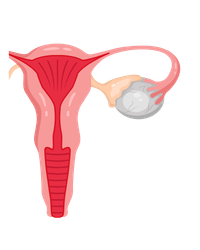
Endometriomas (“Chocolate Cysts”)
  • Medical therapy alone rarely resolves endometriomas
  • GnRH agonists (e.g., leuprolide) may temporarily shrink them, but are not recommended as a standalone treatment before surgery
  • Post-surgery: Long-term oral contraceptives or levonorgestrel IUD significantly reduce recurrence and improve pain control
PCOS (Polycystic Ovaries)
  • PCOS involves multiple small follicles, not true cysts, requiring removal
  • First-line treatment: Lifestyle changes + metformin (if insulin resistant) + ovulation induction (e.g., clomiphene) for fertility
  • Oral contraceptives help regulate cycles and reduce androgen symptoms (acne, hair growth), but don’t “cure” PCOS

Always discuss supplements with your gynaecologist.
Some (like high-dose estrogenic herbs) may worsen hormonal imbalance.

When to Switch from Medicinal to Surgical Treatment

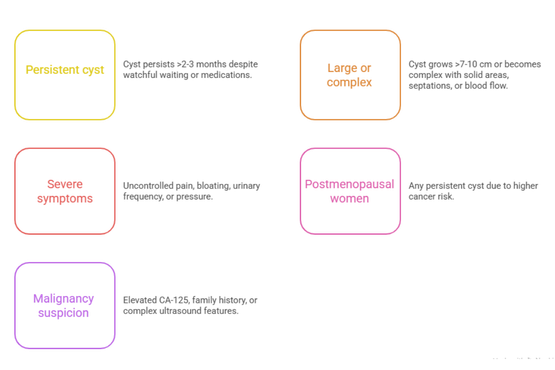
Consider laparoscopic surgery if:

  • Cyst persists >2-3 months despite watchful waiting or medications
  • Cyst grows >7-10 cm or becomes complex (solid areas, septations, blood flow on Doppler). Severe symptoms: Uncontrolled pain, bloating, urinary frequency, or pressure
  • Postmenopausal women with any persistent cyst (higher cancer risk)
  • Suspicion of malignancy: Elevated CA-125, family history of ovarian cancer, complex ultrasound features.

Advanced Robotic & LaparoscopicGynecological Surgeon in Gurugram

Dr Amita Shah is one of the top Gyneacologists & is one of the best robotic laparoscopic surgeons in India for taking care of women, from adolescence to menopause to the elderly stage.

A surgeon combining decades of experience with robotic precision.

FAQs: Medicinal Treatment for Ovarian Cysts

No. Pills help prevent new cysts but don’t speed up the resolution of existing functional cysts compared with watchful waiting.

Typically, 2-3 menstrual cycles (8-12 weeks) for functional cysts. If the cyst persists, grows, or causes symptoms, surgery may be recommended.

If you’re actively trying to conceive, hormonal contraceptives aren’t suitable. We focus on watchful waiting and timely surgery if needed, with ovary-sparing techniques.

No. GnRH agonists (like leuprolide) are not routinely recommended before endometrioma surgery and don’t prevent recurrence as effectively as post-op oral contraceptives or IUDs.

Postmenopausal cysts need closer monitoring due to higher cancer risk. Simple cysts <5 cm with normal CA-125 may be monitored; complex or persistent cysts often require surgery.

Book an Appointment