


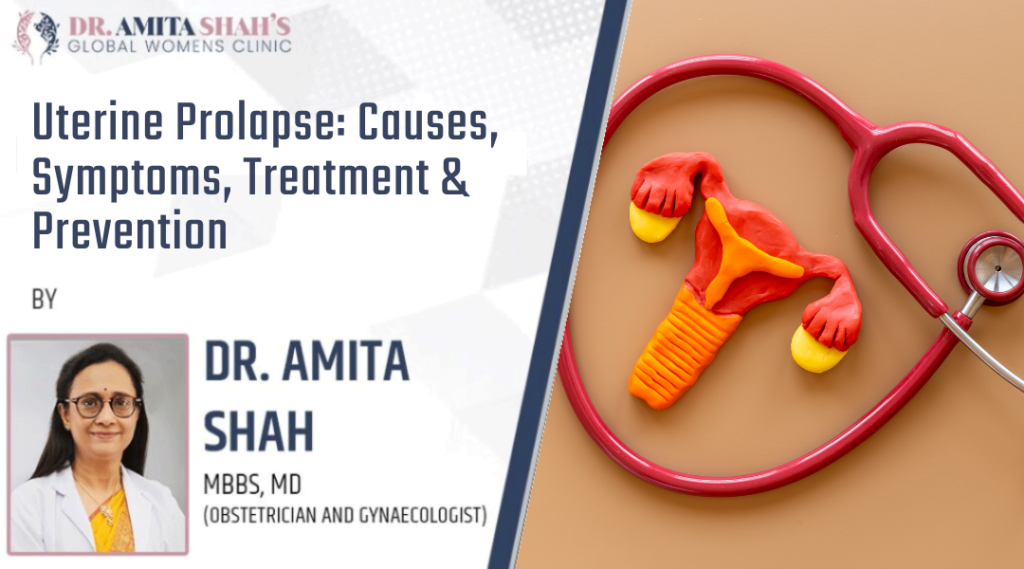
What is Uterine Prolapse?
Uterine prolapse is a medical condition where the uterus slips into the vaginal passage due to weakened pelvic muscle and ligaments.
Now, why does uterine prolapse occur? If the uterus or womb is observed, it is located at this level inside the vagina. Slowly, it starts to move down through the lower part of the uterus, and this condition is referred to as uterine prolapse.
Why Does Uterine Prolapse Occur?
If the uterus or womb is observed, it is located at this level inside the vagina. Slowly, it starts to move down through the lower part of the uterus, and this condition is referred to as uterine prolapse.
Stages of Uterine Prolapse
There are many stages of uterine prolapse:
-
Uterine Prolapse First Degree
The first stage occurs when the uterus slips slightly downward.
-
Second Degree Uterine Prolapse
In the second stage, the uterus is seen outside the body, reaching the end of the vagina.
-
Third Degree Uterine Prolapse
In the third stage, it comes out of the vaginal passage.
-
Fourth Degree Uterine Prolapse
In the fourth stage, the entire uterus moves downward. So, there are four degrees of this condition.
What Are the Causes of Uterine Prolapse?
-
Multiple Deliveries
The most common cause of uterine prolapse is multiple deliveries. During a normal delivery, the muscles or ligaments that hold the uterus in place become loose. After delivery, if exercises are not performed, these ligaments gradually loosen, and the uterus begins to prolapse.
-
Genetic Factor
In some cases, it is genetic, meaning that if your mother or sister had uterine prolapse, you may be more likely to experience it due to weaker pelvic muscles or ligaments. It is not necessary that uterine prolapse only occurs in old age, at 60 or 70 years. It can sometimes occur in young patients who are 30 years old, or sometimes even earlier, at 20 or 25 years. However, it typically occurs later in life, and the cause is generally genetic or due to an internal defect, where the muscles are loose, leading to the condition.
What Are the Symptoms of Uterine Prolapse?
Now, let’s talk about the uterine prolapse symptoms. The symptoms vary depending on the stage of the uterine prolapse.
-
Stages 1 & 2
In stage one, the uterus mildly slips down into the vaginal canal. In stage two, the uterus reaches the mouth of the cervix. In stages one and two of prolapse, the common symptoms are lower abdominal heaviness, occasional pain, backache, or a sensation that something is stuck in the vaginal canal.
-
Stage 3
In the third degree of uterine prolapse stage, the uterus starts to protrude outside, and when lying down, it goes back inside. In this stage, the symptoms include a constant feeling of something hanging between the legs, difficulty urinating, and the need to push the prolapse or the uterus back in to be able to urinate. Constipation is also common, and sometimes the uterus needs to be pushed back inside before bowel movements can occur.
-
Stage 4
Stage four prolapse is a condition in which the entire uterus protrudes outside, and even if an attempt is made to push it back inside manually, it does not go in. This is also referred to as procidentia.
Treatment for Uterine Prolapse
What is the treatment for uterine prolapse? Is surgery required in every case where the uterus protrudes? Absolutely not. The management or surgery depends on the specific situation and the stage of uterine prolapse.
Laparoscopic Surgery for Uterine Prolapse
Now, let’s talk about prolapse at a young age. For younger patients with stage two prolapse, laparoscopic surgery (minimally invasive surgery) may be performed. In this, a surgery is performed, which is also called laparoscopic surgery. Laparoscopy means that the surgery is done using a telescope, also referred to as minimally invasive surgery. In this procedure, a sling or mesh is placed over the uterus, and it is pulled back into position with the help of a tool and fixed to a certain segment. To explain it in simple terms, essentially, the natural ligaments or muscles are converted into an artificial mesh, which is then used to fix the uterus in its normal position.
After a sling operation for uterine prolapse, pregnancy is allowed after 6 months or a maximum of 1 year. However, the most important thing to note is that delivery will have to be done via cesarean section.
Treatment in Older Age
Now, let’s discuss the second condition, where uterine prolapse occurs in older age. For example, if this prolapse occurs at the age of 50, the treatment varies depending on whether it is first-degree, second-degree, or third- or fourth-degree prolapse. Generally, in second third, or fourth-degree prolapse, uterine removal is advised because even if a sling operation for uterine prolapse is performed, the chances of recurrence increase significantly.
If uterine removal is needed in the second or third degree of uterine prolapse, it can be done vaginally, a procedure known as vaginal hysterectomy. This is also a very simple operation. The approach is made through the vagina or the cervical route. The ligaments that hold the uterus in place are cut, and the uterus is removed. Afterwards, some muscles are tightened to provide additional support.
Now, if you are at an age or in a condition where surgery is not possible, such as having uncontrolled diabetes, or heart disease, or if fitness is not cleared by a doctor for uterine prolapse surgical management, then uterine prolapse surgical management is not opted for. In such cases, a pessary is used, which is also known as a ring pessary. This ring pessary helps push the uterus back inside. However, every 3 weeks, the uterine prolapse ring pessary must be removed, washed, and reinserted.
Preventive Measures for Uterine Prolapse
The most important measure is that when you go for a normal delivery, it should be done in a hospital with the guidance of a doctor. This helps avoid problems like difficult delivery and the issues related to first-stage labor. During pregnancy and after delivery, one should perform exercises known as Kegel exercises. These are simple exercises where you tighten the muscles of the pelvic floor. It is essential to do this post-delivery. Additionally, all conditions that increase the internal abdominal pressure should be avoided, such as chronic constipation, chronic coughing, and lifting heavy weights. If these precautions are followed, uterine prolapse can be prevented.
Summarizing the prevention:
-
Proper Delivery
Delivering in a hospital with proper medical guidance can help avoid complications during labor.
-
Pelvic Floor Exercises
Performing Kegel exercises during and after pregnancy can help strengthen pelvic floor muscles. These exercises involve tightening the pelvic floor muscles, which can support the uterus and prevent prolapse.
-
Avoid Strain
Conditions that increase internal abdominal pressure, such as chronic constipation, coughing, or lifting heavy objects, should be avoided.
Consult the Best Gynecologist for Uterine Prolapse Treatment
For effective treatment of uterine prolapse, consult the best gynaecologist in Delhi.
Doctor Profile
Dr. Amita Shah is the Best gynecologist in Delhi NCR (Gurgaon), with extensive experience in treating uterine prolapse and other gynecological conditions. She is a renowned laparoscopic surgeon, skilled in advanced robotic laparoscopic surgery. Dr. Shah currently leads the Obstetrics and Gynecology department at Apollo Cradle and Miracles Mediclinic in Gurgaon. For consultations, you can reach her at +91-8800188335 or via email at info@amitashah.com.